
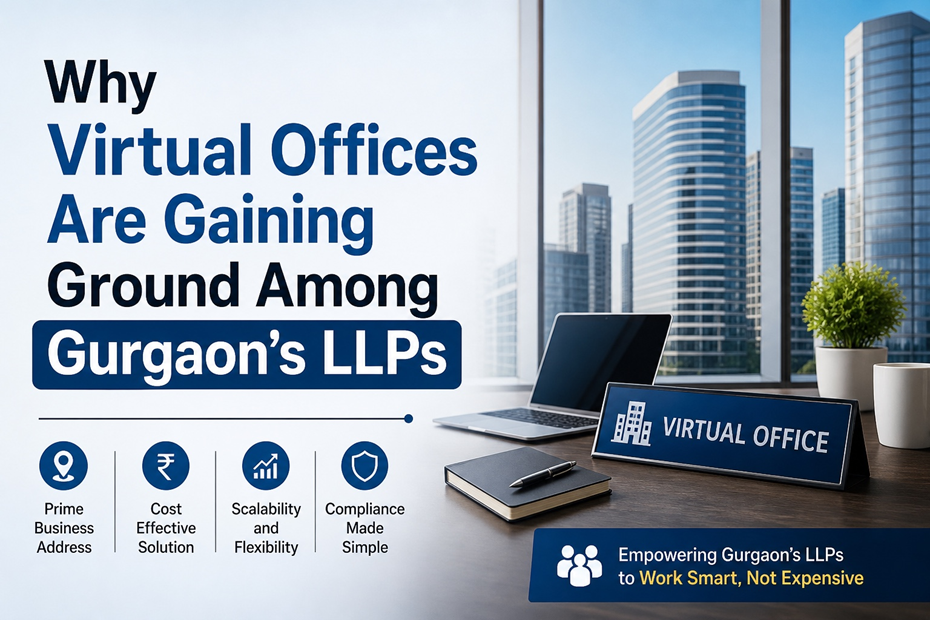
LLP registration in Gurgaon is gaining significant momentum, and much of it is due to a very straightforward concept. The founders are opting for a virtual office instead of signing a lease. The Ministry of Corporate Affairs data shows that the number of LLP incorporations in the country increased by 40% in FY 2025-26, compared with the previous year, to 86,476 from 61,769, respectively[1] .
A considerable portion of those gains has been absorbed by Gurgaon, where the number of consulting firms, CAs, and boutique advisory firms is massive.
The Numbers Behind the Surge
According to MCA data, 1.31 lakh new entities were registered in India between January and April 2026. LLPs made up 39,774 of that[2] , roughly 30% of everything registered in those four months. April alone brought in 10,424 new applications for LLP registration, the strongest single month for the structure so far this year.
A lot of that momentum comes from Gurgaon’s professional services segment specifically. Small partner-led firms that don’t need to chase equity funding gravitate toward LLPs naturally, and Gurgaon has plenty of them. Haryana now counts around 12,000[3] DPIIT-registered startups, most based in Gurgaon, spread across fintech, SaaS, consulting, and other professional services.
Rent is the Other Half of This Story
Rent explains a lot of this. Gurgaon’s commercial rates have climbed hard over the past year, and that’s changing what founders decide the moment they sit down to register. Cyber City, Golf Course Road, Sohna Road, Grade-A space in those pockets now costs ₹90-200 per square foot a month, some of the priciest rates anywhere in North India. Delhi-NCR pulled in about 2.8 million square feet of gross office leasing in Q1 2026[4] alone, and Gurgaon grabbed the largest share.
For a two or three-partner LLP that just registered, none of that math makes sense. Security deposits in premium Gurgaon buildings often run six to ten months of rent, paid upfront, before a single client contract has landed. Coworking seats run cheaper, ₹5,000-16,000 a month, but even that’s overhead a new firm might not need right away.
A virtual office in Gurgaon sidesteps most of this. It gives a new LLP a registered address the MCA and GST authorities will actually accept, without the multi-year commitment or the six-figure deposit that comes with premium real estate. The firm gets its Form FiLLiP filed, its address verified, and doesn’t spend working capital on a floor it doesn’t need yet.
Why This Pairing Makes Sense for LLPs Specifically?
An LLP needs a registered address on file before the MCA will approve incorporation, and that address has to survive GST verification too if the firm registers separately for tax. A virtual office provider typically hands over a rent agreement, an NOC from the property owner, and a recent utility bill, essentially the same documents an actual landlord would give, minus the landlord and the lease.
This matters more for LLPs than for, say, a funded startup that’s planning a full office from month one. Most LLPs are small, two or three partners, running on tight margins in the early years. A consulting LLP doesn’t need a floor in Cyber City to get started. It needs an address the ROC won’t flag, and one that holds up if the firm ends up registering for GST in more than one state.
Here’s the part people skip: the ROC and GST department don’t just accept any address on paper. They can, and sometimes do, send verification visits to check that the address is real and active. An address that fails that check doesn’t just delay registration; it can put the whole filing back to square one.
What to Check Before Signing Up?
Not every provider handles this the same way, and picking the wrong one can cause real problems later. A few things worth confirming before you commit:
● Whether the documents, rent agreement, NOC, and utility bill actually hold up during GST and ROC verification, not just look fine on paper.
● Whether the provider has a track record with your specific ROC jurisdiction, since acceptance standards vary slightly by state.
● Whether mail handling is included, since statutory notices go to that address and someone has to actually check for them.
● Whether you get occasional access to a meeting room for client calls, without paying for a desk that sits empty most of the year.
The National Picture Still Favours Private Limited, But Not by as Much
Private limited companies still lead by volume nationally, 85,560 of the 1.31 lakh new registrations between January and April 2026, against LLPs’ 39,774. But the growth rate tells a different story. LLP filings are climbing faster in percentage terms, mostly because they suit a specific kind of founder: professionals and small partnerships who don’t need equity investors and would rather keep compliance simple.
In Gurgaon, that national trend runs straight into the city’s rent problem. A firm that would have signed a two-year lease in Udyog Vihar or DLF Phase 2 five years back is now far more likely to register with a virtual office instead for the first year or two, and only think seriously about physical space once there’s enough client revenue to justify it.
The Road Ahead
With LLP registrations up 40% nationally and Gurgaon’s commercial rents showing no sign of cooling in the premium corridors, this pairing of LLP registration and virtual office use looks likely to keep strengthening through the rest of 2026. For Gurgaon’s smaller professional firms, it’s stopped being a workaround. It’s just how people are starting firms here now.
https://startupfeed.in/india-llp-registrations-2026-high/
https://startupharyana.gov.in/pages/about-startup-haryana
https://realtynmore.com/delhi-ncr-office-leasing-jumps-36-in-q1-26/