
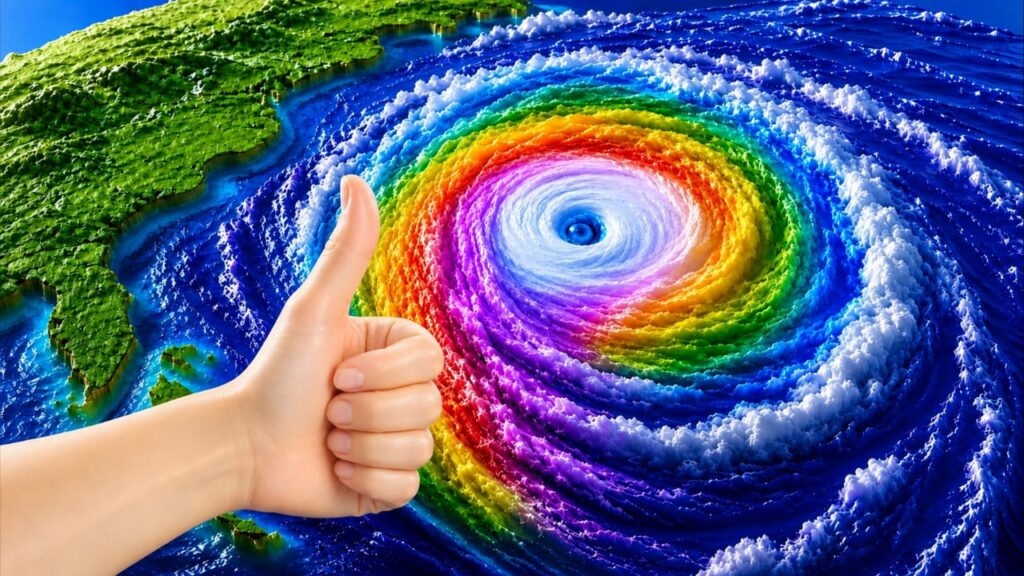
Understand wind rotation direction in seconds using the right- and left-hand rule—a simple visual method for students.
Dausa, Rajasthan. Remembering the direction of wind rotation in cyclones and anticyclones across the Northern and Southern Hemispheres used to be a complex and confusing task for students; however, this concept has now become very easy to grasp thanks to a new rule. R.K. Pilot, a resident of Nangal Lotwara village in Rajasthan’s Dausa district, developed the ‘Right and Left Hand Rule’ to help understand and memorize wind directions. This educational concept was published in the International Educational Scientific Research Journal.
What is R.K. Pilot’s Hand Rule?
The basis of this rule is remarkably simple. The right hand is used for the Northern Hemisphere, and the left hand for the Southern Hemisphere. The direction of the thumb indicates whether the air is rising or sinking, while the curled fingers show the direction of wind rotation.
In the Northern Hemisphere-
- Point your right hand’s thumb straight up and curl your fingers towards the palm, the thumb indicate rising air, while the fingers represents the rotation of wind in a cyclone, which rotate in an anti-clockwise.
- Point your right hand’s thumb straight down and curl your fingers towards the palm, the thumb indicate sinking air, while the fingers represents the rotation of wind in an anticyclone, which rotate in a clockwise.
In the Southern Hemisphere-
- Point your left hand’s thumb straight up and curl your fingers towards the palm, the direction of the thumb indicate rising air, while the direction of the fingers represents the wind circulating within a cyclone—which rotate clockwise.
- Point your left hand’s thumb straight down and curl your fingers towards the palm, the direction of the thumb indicate sinking air, while the direction of the fingers represents the wind circulating within an anticyclone—which rotate anti-clockwise.
Why is this method important in meteorology?
Meteorology encompasses the study of weather, climate, and the Earth’s atmosphere. Cyclones and anticyclones are key components of this field. In competitive exams as well as in school and college curricula, students are frequently asked questions regarding wind directions in both hemispheres.
R.K. Pilot’s method emphasizes visually grasping the concept using one’s hand rather than relying on rote memorization. This approach can help students remember wind directions associated with cyclones and anticyclones in both the Northern and Southern Hemispheres.
The concept is linked to the Coriolis effect.
This rule serves as an educational tool to help remember the scientific concepts of rising and sinking atmospheric air and the Coriolis effect—which influences wind direction due to the Earth’s rotation. Its purpose is not to alter scientific theory but to facilitate the understanding and retention of complex directional patterns.
Why did R.K. Pilot devise this rule?
According to R.K. Pilot, students and researchers often get confused about wind directions in cyclones and anticyclones across the Northern and Southern Hemispheres. To address this issue, he developed a method that allows these patterns to be easily remembered simply by observing hand positioning. He believes that once students grasp this rule, they can determine the direction of wind circulation in both hemispheres simply by observing the orientation of their thumb and the curvature of their fingers.
Promoting Visual and Hands-on Learning
Visual and hands-on activities in teaching can be instrumental in helping students understand complex scientific concepts. “R.K. Pilot’s Hand Rule” is one such method that uses the direct application of one’s hand to explain the direction of cyclones and anticyclones.
This rule by R.K. Pilot was first published in the International Educational Scientific Research Journal in August 2017.
R.K. Pilot’s orginal name is Ramkrishan. After undergoing pilot training for the airline industry, he has been working in the field of research. His parents are Smt. Rukmani Devi and Shri Lallu Ram.
According to the Global Science Journal, R.K. Pilot’s educational rule—utilizing the right and left hands—offers a simple and memorable way to understand wind directions associated with cyclones and anticyclones in meteorology. Such straightforward educational methods can help students easily grasp complex scientific concepts.