
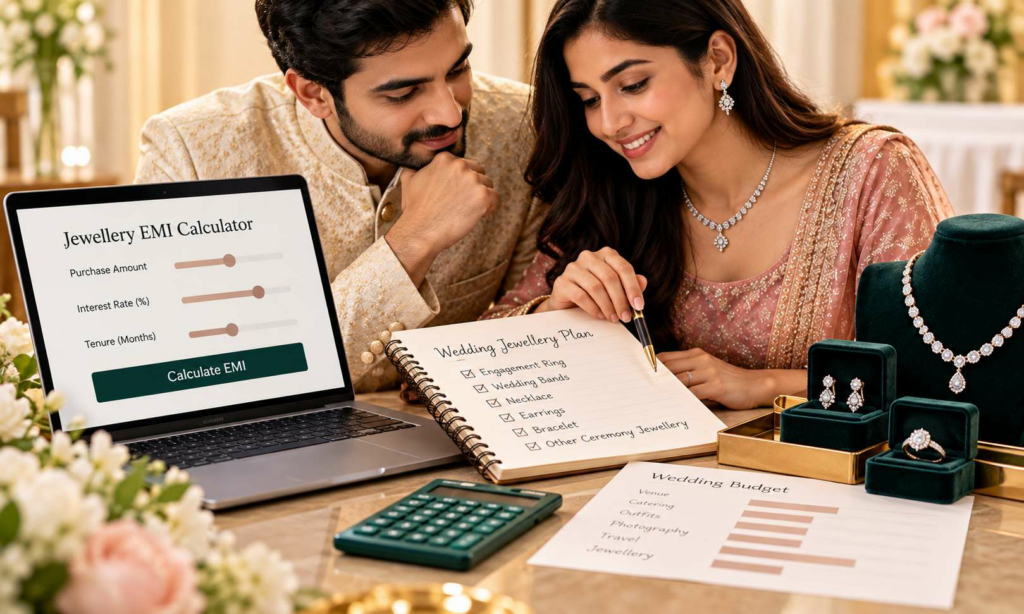
Wedding jewellery quietly takes over budgets. A couple plans for the engagement ring, then the reception set, then something for the festive ceremonies, and the total ends up far above what anyone sketched on day one. That is the real planning problem.
Splitting payments over time can help, but only if you know what each piece costs and what the installments will add up to. Used well, a jewellery EMI calculator turns a vague monthly figure into a number you can actually test against the household budget.
Set A Realistic Wedding Jewellery Budget
Start with the whole wedding, not the jewellery. Venue, catering, outfits, photography and travel all compete for the same pool of money, and jewellery tends to get what is left over or, worse, what feels emotionally right in the shop.
A wedding diamond jewellery budget works better when it is carved out early, as a fixed share of the total spend. Many couples settle somewhere between a tenth and a fifth, though family contributions, gifting traditions and existing gold holdings change this a lot. There is no universal split.
Some points worth settling before you visit a single store:
- Who is paying for what: Two families, two sets of expectations. Clarify this early.
- What already exists: Inherited pieces or gold due for exchange can shrink the buying list.
- A buffer: Last-minute additions are almost guaranteed. Keep a small cushion.
- A hard ceiling: One number, agreed by both partners, including tax and making charges.
Prioritise Pieces For Ceremonies And Everyday Use
Not every piece earns its place equally. Bridal jewellery budgeting is mostly an exercise in sorting what will be worn once from what will be worn for years.
Indian weddings vary widely. Some couples hold a formal engagement ceremony, others skip it. Some have a single wedding day, some have a week of functions. A reception may call for contemporary diamonds, while a traditional ceremony may lean on gold. Your own mix is the only one that counts.
Here is a simple way to sort the list:
- Must-have: The engagement ring and wedding bands, plus whatever your ceremony customs require.
- High-use: Earrings, a pendant or a bracelet that suits daily wear and office settings.
- Occasion pieces: A statement necklace or a bridal set for specific functions.
- Optional: Anything bought mainly because the outfit “needs” it. Rental or lighter alternatives sometimes work fine here.
Engagement rings and wedding jewellery also differ in how they are worn. A ring sees daily friction, so a secure setting matters more than ornate detailing. A necklace worn twice a year can afford to be more elaborate.
One honest observation: pieces that can be styled across several occasions usually deliver better value per rupee than a single heavy set.
Understand How A Jewellery EMI Calculator Works
A jewellery EMI calculator does one job. It takes the amount being financed, the interest rate and the repayment period, and returns an approximate monthly instalment. That is it. It does not know about your other loans, your income or your lender’s fees.
The inputs are usually these:
- Principal: the purchase price minus any down payment
- Interest rate: annual, as offered by the lender or card issuer
- Tenure: the number of months over which you repay
The standard formula behind jewellery EMI calculation is
EMI = P × r × (1 + r)^n ÷ ((1 + r)^n − 1)
where r is the monthly interest rate and n is the number of months. You do not need to do this by hand, but it helps to see why a longer tenure lowers the instalment while raising total interest.
A quick illustration, using round numbers for clarity only: on a ₹1,00,000 piece with no down payment, a 12-month plan at 12% annual interest comes to roughly ₹8,885 a month, or about ₹6,600 in total interest. Stretch it to 24 months and the monthly figure drops to around ₹4,707, but total interest roughly doubles. Actual rates and terms depend on the lender.
If you want to see what is available before running numbers, you can explore jewellery and EMI payment options at Lucira Jewelry and then plug the lender’s terms into any standard calculator. Check the collection page for the specific plans offered, since availability and terms can change.
Compare Down Payments, Interest And Repayment Periods
Monthly EMI for diamond jewellery looks different depending on three levers. Moving any one of them shifts the others.
|
Lever |
Effect on Monthly Payment |
Effect on Total Cost |
|
Larger down payment |
Lower |
Lower, since less is financed |
|
Longer tenure |
Lower |
Higher, because interest accrues for longer |
|
Higher interest rate |
Higher |
Higher |
|
“No-cost” EMI |
Appears lower |
May be built into the price or fees, so verify |
The temptation is to chase the smallest monthly figure. Resist it. A low instalment over a long tenure can cost noticeably more than a mid-range instalment over a shorter one.
Also ask about the “no-cost” label. In many cases the interest is either deducted as a discount that is then withdrawn, or folded into the product price. It is not always a free lunch, though sometimes the economics do work out. Compare the effective price to the cash price and decide from there.
Check Eligibility, Fees and Payment Conditions
Approval is not automatic. Lenders look at credit history, income and existing obligations, and terms can differ between a credit card EMI, a debit card EMI and an instalment plan from a financing partner.
Before committing, confirm these in writing:
- Eligibility criteria: minimum income, credit score or card type required
- Processing fees and GST on them: often small, rarely zero
- Down payment requirements: whether one is needed and when it is due
- Foreclosure and prepayment charges: useful if gifts or bonuses arrive mid-tenure
- Late payment penalties and credit reporting: missed instalments can affect your credit record
- Return and exchange rules: what happens to the EMI if the piece is returned
Two things tend to get missed. First, a card-based EMI can reduce your available credit limit for the duration. Second, if the wedding already involves other loans, lenders will see the combined load.
Make a Purchase Decision that Fits the Household Budget
By now the sequence should be clear. Fix the jewellery budget within the wider wedding plan, sort pieces by priority, estimate installments, compare the full repayment amount against the cash price, and check the conditions. Only then decide.
A few final tests help:
-
1.Can the monthly instalment be paid comfortably after rent, bills, savings and other EMIs?
-
2.Is the total repayment acceptable, not just the monthly figure?
-
3.Would you still be comfortable if one partner’s income dipped for a few months?
-
4.Is every piece on the list one you will actually wear?
If the answer to any of these is hesitant maybe, shrink the list or raise the down payment. Financing should make a well-planned purchase easier. It should never be the reason an unplanned one happens.