
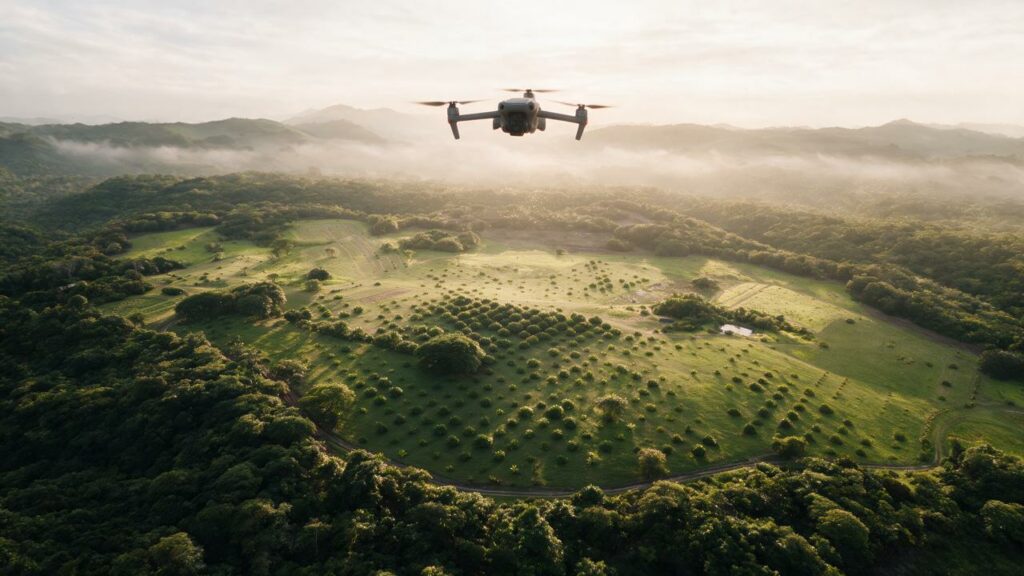
Forests VC uses an acquisition-and-development model for productive land, applying its FINCA Framework to identify unrealized potential and build diversified natural assets.
Real estate developers rarely value a property solely by what stands on it today.
They consider location, infrastructure, market demand, alternative uses, and what strategic development could make the asset.
Forests VC is bringing a similar mindset to natural capital.
Co-founded by regenerative finance executive Ronny Castillo and business strategist Kimberly Lacayo, the company is building an acquisition and development platform around undervalued farms and other promising landscapes.
The objective is straightforward: identify land with unrealized potential, develop the productive systems best suited to it, and create a more valuable and resilient natural asset.
Costa Rican businessman and business partner Marco Zúñiga captures the starting point:
“The question extends beyond what the land is worth today. It’s what the land could become.”
Forests VC intends to make answering that question repeatable through its FINCA Framework: Acquire, Design, Grow, Measure, Optimize, and Connect.
Acquisition begins with finding the right property. Design considers what the land, water, climate, infrastructure, and markets can realistically support. Growth brings productive systems to life. Measurement provides information to improve performance. Optimization seeks additional value across the property. Connect brings together markets, expertise, and capital.
The resulting development may look very different from the farm that preceded it.
High-value regenerative forestry can create biological growth with long-duration asset value. Agriculture can generate nearer-term revenue. Processing can retain additional margin from what the property produces. Applied circular systems can turn byproducts into productive inputs or additional outputs. Tourism and measurable ecosystem services may contribute further opportunities where appropriate.
For Forests VC Head of Asset Management and agronomist Adrian Vargas, turning that potential into performance requires attention to the operating systems beneath the asset. His focus includes agricultural systems, irrigation, crop efficiency and logistics.
“A productive property is a system,” Vargas says. “When you improve how water, crops, operations and markets work together, you can improve more than production. You can strengthen the economics of the underlying asset.”
For Lacayo, whose background includes business strategy, ESG and corporate social responsibility, the opportunity lies in integrating those systems around value creation.
“Better stewardship should be one of the reasons the asset becomes more valuable,” she says.
Technology can strengthen that process through remote sensing, ground-level monitoring and digital-twin capabilities, creating greater visibility into how a property changes over time.
Capital completes the equation.
Castillo began his career in conventional finance before moving into regenerative finance and natural capital. He also serves as President of Raíz de Oro, the Costa Rican development where the broader group intends to put much of this thinking into practice.
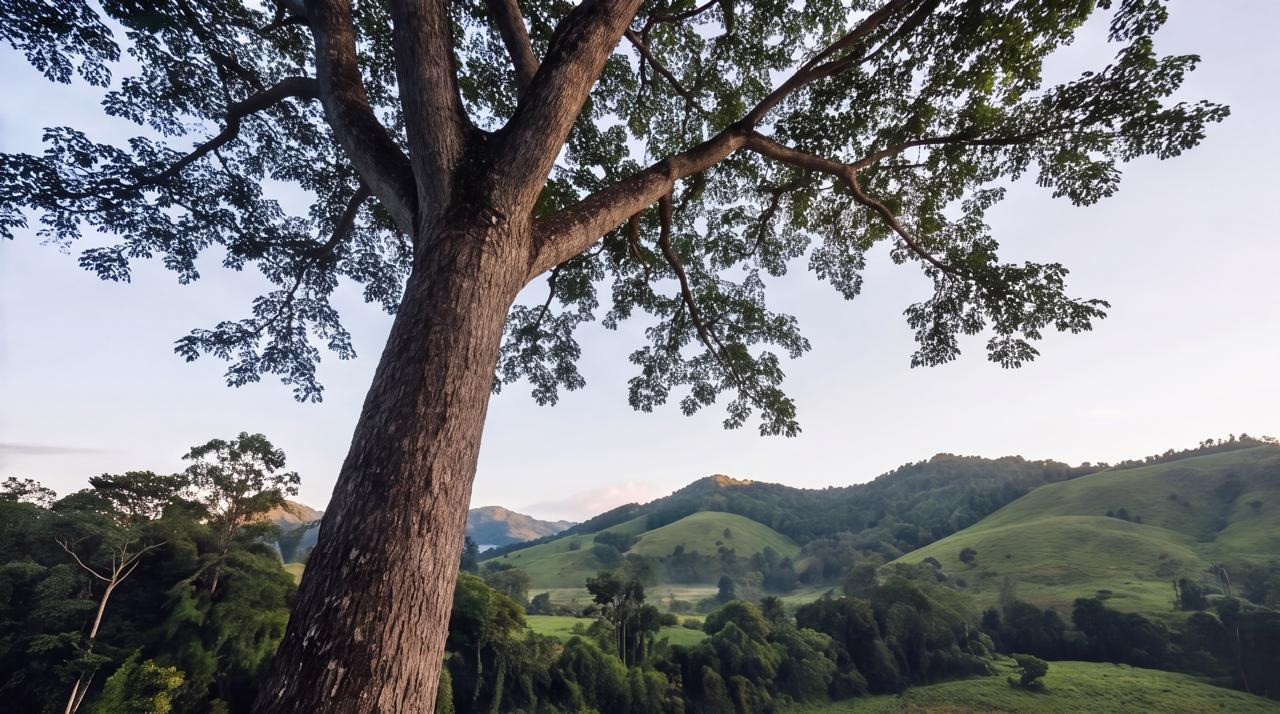
“The challenge isn’t finding capital,” Castillo says. “It’s building natural assets that deserve it.”
That philosophy points toward a business model larger than developing a single farm.
Forests VC ultimately envisions a pipeline of properties where its team can acquire, partner, develop, operate, optimize, and potentially recapitalize or exit improved natural assets. Creative financial structures may also broaden participation over time while keeping the underlying asset’s economics at the center.
The model therefore creates opportunity on both sides.
Landowners and deal sources can bring properties whose potential exceeds their present use. Investors can bring capital seeking differentiated real assets. Forests VC and FINCA provide the development architecture between them.
The concept is familiar to anyone who understands value-add real estate or private equity.
Find overlooked potential. Bring together the right expertise and capital. Improve the underlying asset. Build new sources of value. Make the process repeatable.
Forests VC simply proposes that some of the most interesting assets waiting to be developed may already be growing beneath our feet.