
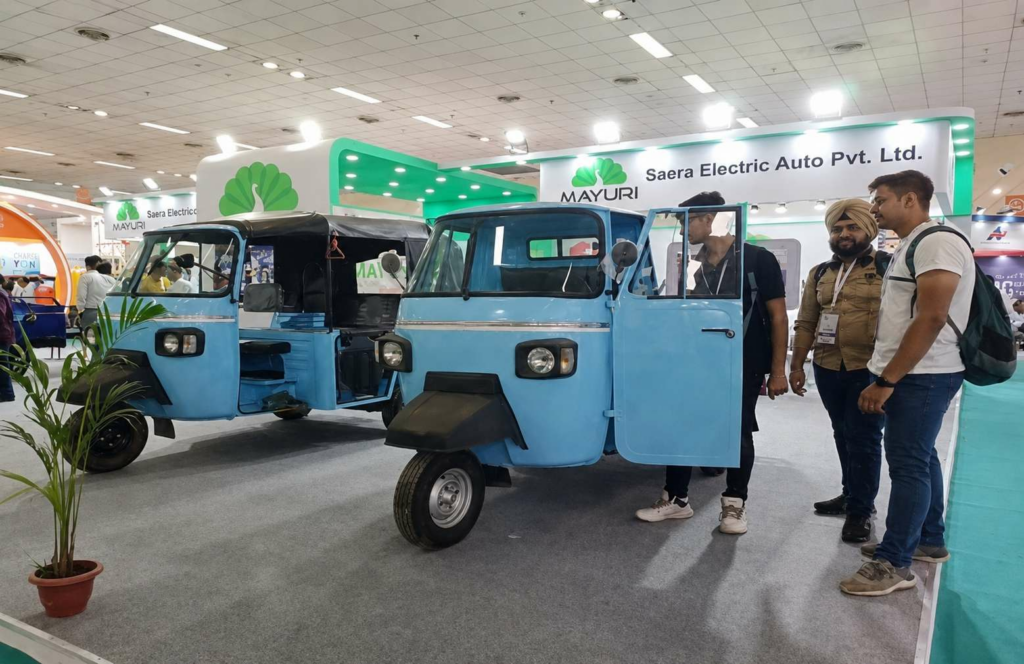
There is no separate category called “Auto Shape” or “Non-Auto Shape” for three-wheelers under the Central Motor Vehicles Rules (CMVR), 1989. These are essentially industry or market terms and should not be treated as statutory vehicle classifications.
Under the CMVR framework, electric three-wheelers broadly fall into specific regulatory categories, including special-purpose battery-operated E-Rickshaws/E-Carts and L5-category three-wheelers, subject to their applicable technical requirements.
The key distinction between an E-Rickshaw/E-Cart and an L5 vehicle is not simply the vehicle’s shape. E-Rickshaws and E-Carts have a maximum permissible speed of 25 km/h, along with other prescribed specifications such as motor power and passenger/load capacity.
L5 vehicles are separately classified under the CMVR framework and are designed for specifications beyond those applicable to the special-purpose E-Rickshaw/E-Cart category, including higher-speed configurations.
Therefore, an electric three-wheeler should be classified based on its official CMVR category, technical specifications and type approval/homologation, rather than whether it looks like an “auto” or a “non-auto.”
In short, “Auto Shape” and “Non-Auto Shape” are not CMVR categories. The actual regulatory classification depends on the vehicle’s approved category and specifications, with the 25 km/h limit being a key defining feature of the E-Rickshaw/E-Cart category.