
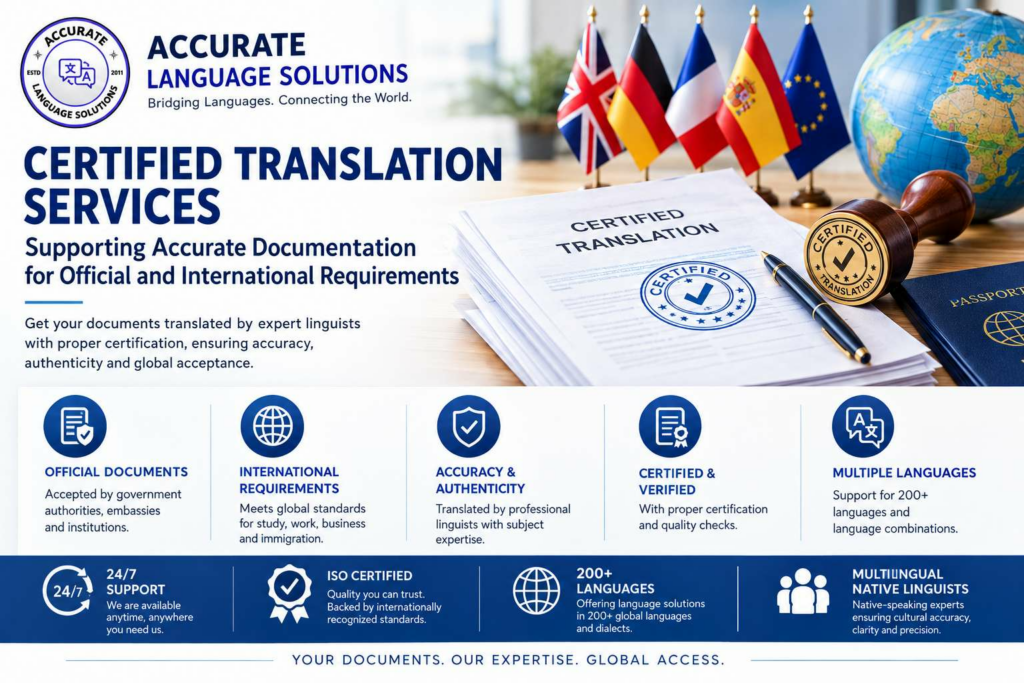
As individuals, educational institutions and businesses increasingly manage documentation across borders, accurate translation has become an important part of administrative, legal, academic and commercial processes. From immigration applications and university admissions to business agreements and international transactions, documents often need to be translated into a language accepted by the receiving authority. Certified Translation Services help address these requirements by providing translated documents accompanied by an appropriate certification or declaration, depending on the purpose and the institution’s rules.
The need for certified translation extends beyond converting words from one language to another. Names, dates, official terminology, seals, signatures and document formatting may all affect how a translated document is reviewed. Understanding the receiving organisation’s requirements before starting the translation can help applicants and businesses avoid preventable delays.
Why Certified Translation Is Important
Official documents frequently contain information that must remain consistent with the original. A translation may be required for submission to a government department, university, court, embassy, employer, financial institution or overseas business partner.
Common documents requiring certified translation include birth and marriage certificates, educational transcripts, degree certificates, passports, identity documents, legal agreements, court records, medical reports and company registration documents. The exact requirements vary according to the document type, destination country and receiving authority.
For example, a student applying to an overseas university may need academic records translated into the institution’s accepted language. An individual preparing immigration documents may be asked to submit certified translations of civil certificates. Businesses entering an international market may require translated corporate records or agreements for administrative review.
In each case, it is important to establish whether the recipient requires a certified translation, a sworn translation, notarisation, an apostille or another form of authentication. These terms are not interchangeable, and one process does not automatically replace another.
What Do Certified Translation Services Include?
Certified Translation Services generally involve translating a document and providing a certification or statement confirming the translation’s completeness and accuracy, subject to the applicable requirements and service arrangement.
The process typically begins with reviewing the source document and identifying the target language. The translator then converts the content while preserving the meaning, names, dates, figures and relevant formatting. A review stage helps identify omissions, inconsistencies and terminology issues before the final document is delivered.
Depending on the assignment, certification may include a signed declaration or other supporting details required by the receiving institution. Some authorities specify particular wording, translator credentials, stamps or additional procedures. Therefore, certification arrangements should be confirmed before the work begins.
A certified translation should not be assumed to guarantee acceptance by every authority. Applicants should check the submission instructions issued by the organisation requesting the document.
Documents and Industries That May Require Certified Translation
Translation requirements differ across sectors, and the nature of the document determines the level of subject knowledge needed.
Immigration and civil documentation: Birth certificates, marriage certificates, police records and other personal documents may need translation for visa, residency or citizenship applications. Spelling of names and consistency of dates are especially important.
Academic documents: Degrees, transcripts, diplomas, mark sheets and educational certificates may be required for international admissions, credential assessments or professional applications. Academic terminology and the accurate presentation of grades and qualifications need careful attention.
Legal and contractual records: Agreements, affidavits, court documents and legal correspondence may require specialist translation. The recipient may also specify whether the translator must meet particular qualifications or whether additional authentication is necessary.
Medical and healthcare documents: Medical reports, prescriptions, discharge summaries and related records may need translation when information is shared with healthcare providers or institutions in another country. Medical terminology and confidentiality require particular care.
Business and corporate documentation: Companies may need translated incorporation records, financial documents, compliance materials, policies and commercial agreements for overseas operations, partnerships or regulatory submissions.
Certified Translation and Interpretation Services: Understanding the Difference
Although both support multilingual communication, certified translation and interpretation services serve different purposes.
Certified translation deals with written documents. It is commonly used when official or institutional records must be submitted in another language with the required certification.
Interpretation services, by contrast, support spoken communication during meetings, interviews, consultations, conferences, negotiations and professional discussions. Interpretation may be consecutive, where the speaker pauses for the interpreter, or simultaneous, where the interpreter communicates while the speaker continues.
An organisation may need both services for the same project. For instance, a company preparing documentation for an international partnership may require certified translations of official records and interpretation services during meetings with overseas representatives. Similarly, an individual managing an administrative process may need translated documents as well as language support during an appointment.
Choosing the appropriate service for each situation helps ensure that both written records and spoken discussions are handled according to their specific requirements.
How to Choose a Reliable Translation Provider
Selecting a provider requires consideration of accuracy, language expertise, confidentiality and the requirements of the receiving authority. Before commissioning a translation, individuals and businesses should confirm the following:
- Language expertise: Ensure the provider can support the required source and target languages and has suitable experience with the document type.
- Certification requirements: Share the recipient’s instructions so the provider can confirm the appropriate certification arrangement.
- Quality review: Ask about proofreading, terminology checks and verification of important details such as names, dates and reference numbers.
- Confidentiality: Establish how personal, legal, medical and commercial documents will be handled and protected.
- Delivery timelines: Confirm the expected completion date, format and whether physical copies or signed declarations are required.
- Additional authentication: Check separately whether notarisation, an apostille, sworn translation or another official procedure is needed.
Providing clear instructions and legible source documents at the beginning can help reduce queries and avoid unnecessary revisions.
Preparing Documents for Translation
Before submitting documents, applicants should review the requirements of the institution that will receive them. Some authorities accept electronic copies, while others request signed hard copies, specific certification statements or additional authentication.
Scanned documents should be clear enough to read all text, stamps, signatures and annotations. If a document contains handwritten entries or unclear sections, these should be highlighted for review rather than left open to interpretation. Names should be checked against passports or other official records where consistency is required.
For business and legal projects, supplying background information and approved terminology can also help maintain consistency across multiple documents. Sensitive files should be shared through an appropriate channel agreed with the service provider.
Meeting Multilingual Documentation Needs
As education, employment, immigration and business activities increasingly cross national borders, professionally prepared translations play an important role in helping people and organisations present information clearly. The right approach begins with understanding the purpose of the document, the language combination and the receiving authority’s requirements.
Accurate Language Solutions Private Limited provides language services, including document translation and interpretation support, for individuals and organisations with multilingual communication needs. Those seeking Certified Translation Services can visit Accurate Language Solutions to discuss their documents, target language, certification requirements and expected delivery schedule.
By confirming requirements in advance and selecting a provider with appropriate language expertise, applicants and businesses can prepare translations more efficiently and support clearer communication across official, professional and international settings.