
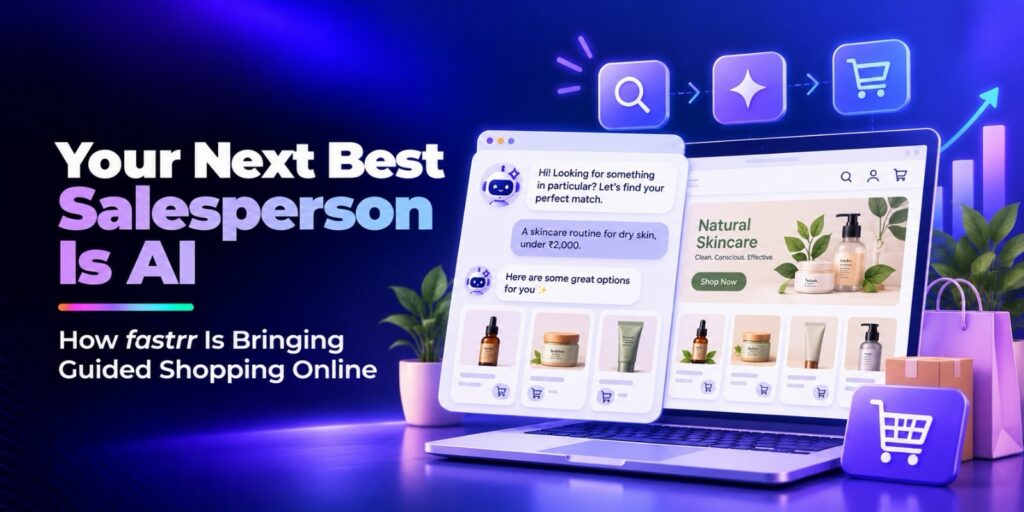
For years, ecommerce businesses have invested in attracting shoppers through advertising, search engine optimisation and social media. Yet getting visitors to a website is only part of the challenge. Customers must still find the right product, understand their options and feel confident enough to complete a purchase.
This is where AI-powered shopping assistants are beginning to change the ecommerce experience. Instead of asking shoppers to navigate multiple categories, apply filters and compare dozens of product listings, these assistants can help customers discover relevant products through natural-language conversations.
fastrr by Shiprocket is addressing this shift through fastrr Assist, an AI shopping assistant designed to guide product discovery, alongside fastrr Checkout, which helps merchants simplify the purchase journey. Together, they reflect a broader change in ecommerce: moving from websites that primarily display products to shopping experiences that actively help customers make decisions.
Why Traditional Ecommerce Stores Need a Better Shopping Experience
Online stores offer convenience and product variety, but these advantages can also create friction. A shopper looking for a skincare routine, for example, may have to compare ingredients, identify products suitable for their needs, check prices and determine which items work well together.
For a first-time visitor, the process can become overwhelming. Product filters and search bars are useful, but they often require customers to know exactly what they are looking for before they begin.
The result is a discovery problem. Businesses may attract qualified visitors who leave without finding a suitable product, while customers may abandon their search because comparing options takes too much effort.
For ecommerce businesses, this means the opportunity is not limited to bringing more visitors to a website. Helping existing visitors find relevant products and make informed purchase decisions can be equally important.
How AI Shopping Assistants Can Act Like Digital Salespeople
In a physical store, a salesperson can ask questions, understand a customer’s requirements and suggest suitable products. An AI shopping assistant aims to bring aspects of that guided experience online.
Instead of relying entirely on keyword searches, shoppers can describe what they need in everyday language. They might specify a budget, explain a particular concern or ask for recommendations based on their preferences.
An AI shopping assistant can use this context to guide product discovery, surface relevant options and help customers compare alternatives. This can make browsing more intuitive, particularly for businesses selling products that require explanation or consideration, such as beauty, wellness, fashion and consumer electronics.
For merchants, the value lies in reducing the effort required to move from a broad need to a relevant product selection. The assistant should complement accurate product information and clear buying guidance, not replace them.
How fastrr Assist Brings Guided Shopping to Ecommerce
fastrr Assist is fastrr’s AI-powered shopping assistant, designed to help shoppers discover products through conversational interactions. Rather than treating a store as a static catalogue, it aims to make product discovery more guided and responsive to what a customer is looking for.
For ecommerce businesses, this creates an opportunity to make product information more accessible and help customers navigate their choices with greater clarity. A shopper who is unsure which product suits their needs can begin with a question instead of having to understand the store’s category structure.
The approach is particularly relevant for merchants with extensive catalogues, multiple product variants or products that benefit from personalised guidance. Its effectiveness depends on factors such as the quality of product information, the relevance of recommendations and how naturally the assistant fits into the store’s shopping journey.
However, product discovery is only one part of the buying process. Even when shoppers find what they want, they may still abandon their purchase if checkout is cumbersome or payment options do not match their preferences.
Why Product Discovery Must Connect With Checkout
A helpful recommendation does not automatically translate into a completed order. Customers can still encounter lengthy checkout forms, difficulty entering delivery details, payment failures or uncertainty about delivery timelines.
These issues matter because merchants need to convert shopping intent into actual purchases without introducing unnecessary friction.
fastrr Checkout addresses this next stage of the journey through capabilities including one-click checkout, address autofill, multiple payment options and estimated delivery information. These features are designed to simplify the steps between selecting a product and placing an order.
The checkout experience also affects what happens after an order is placed. For Indian ecommerce businesses, cash-on-delivery preferences, incorrect addresses and orders that are never accepted at delivery can create additional operational costs.
fastrr Checkout includes capabilities such as AI-driven Return to Origin (RTO) Prediction, configurable COD rules, Partial COD and Address Intelligence to help merchants manage these challenges. Depending on their requirements, businesses can use these capabilities to identify potentially risky orders, introduce proportionate safeguards and address problematic delivery details.
The distinction is important: a shopping assistant helps customers decide what to buy, while checkout capabilities help businesses make purchasing easier and manage risks associated with fulfilment.
What Ecommerce Businesses Should Consider Before Adopting AI Shopping Tools
AI adoption should begin with a clear business problem rather than the technology itself. Merchants should consider where customers struggle most: finding products, understanding differences between options, completing payment or receiving orders successfully.
Product discovery tools should be evaluated on recommendation relevance, the quality of customer interactions and their contribution to meaningful shopping outcomes. Merchants should also ensure product information is accurate, recommendations are transparent and shoppers retain control over their decisions.
At the checkout stage, businesses should track conversion rates alongside payment completion, average order value, COD-to-prepaid movement and RTO rates. Measuring these outcomes together helps merchants determine whether technology is improving the overall shopping experience rather than simply increasing activity at one stage.
Integration also matters. AI-led discovery is more useful when it connects naturally with product pages, cart experiences and checkout, instead of creating another disconnected step for shoppers.
The Future of Ecommerce Is Guided, Not Just Automated
AI shopping assistants represent an opportunity for ecommerce businesses to make online shopping more intuitive, particularly when customers need help navigating choices. But lasting value will depend on how well businesses connect discovery, decision-making, checkout and fulfilment.
fastrr by Shiprocket approaches this opportunity through fastrr Assist for AI-led product discovery and fastrr Checkout for purchase completion and checkout optimisation. For merchants, the broader lesson is that technology should help customers make better-informed decisions while making it easier for businesses to convert genuine purchase intent into completed orders.
The next competitive advantage in ecommerce may not come from displaying more products or attracting more visitors alone. It may come from helping every shopper find what they need, understand their options and move confidently from discovery to purchase.