
Every woman carries a power within her that the world may overlook, circumstances may suppress, but adversity can never truly erase. It is the power of Shakti—the inner force of resilience, courage, transformation and creation.
What makes a woman powerful? Is it her ability to stand tall after being broken by circumstances, to find hope when life feels uncertain, or to rise again when the world expects her to surrender? Perhaps a woman’s greatest superpower is not something she acquires, but something she discovers within herself.
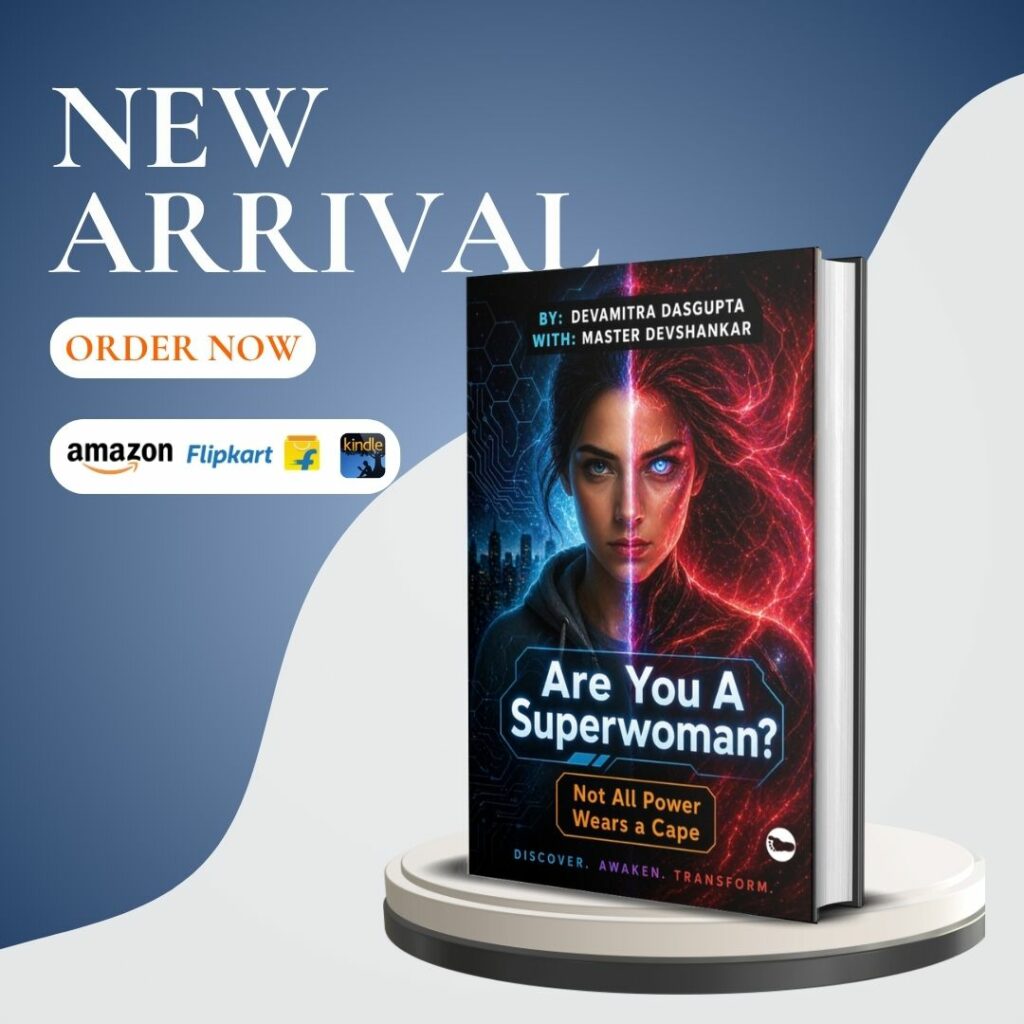
‘In Are You A Superwoman?’, author Devamitra Dasgupta explores this idea through an imaginative blend of fantasy, mythology, adventure and self-discovery. At its heart, the novel is a journey towards recognising the hidden strength that resides within every woman—even when she has forgotten it herself.
Published by Bigfoot Publications in June 2026, the story follows Anvi, a woman whose professional dreams are shaken by workplace humiliation and an unsupportive, hostile environment. Faced with circumstances that challenge her confidence and sense of worth, she finds herself at a crossroads. Yet what appears to be a breaking point becomes the beginning of an extraordinary awakening.
A mysterious Tibetan singing bowl unlocks supernatural abilities within Anvi, revealing a hidden legacy and introducing her to her identity as a Devgon—a being entrusted with extraordinary powers and responsibilities. Her discovery opens the door to mystical realms, ancient weapons and supernatural conflicts, transforming her personal struggle into a much larger quest.
But beneath the fantasy lies a deeply human truth: sometimes, the moments that make us question our strength are the very moments that reveal it.
Anvi’s transformation reflects the resilience many women demonstrate in their everyday lives. It is present in the woman who rebuilds her confidence after humiliation, the mother who finds the courage to begin again, the professional who refuses to let rejection define her, and the woman who quietly carries responsibilities that the world rarely acknowledges. Their struggles may differ, but each holds the possibility of an inner awakening.
This is where the concept of Shakti becomes especially meaningful. Rooted in Indian philosophical and spiritual traditions, Shakti represents the dynamic power of creation, energy and transformation. It is not merely a symbol of divine femininity; in the context of Anvi’s journey, it becomes a powerful metaphor for the strength that can emerge when a woman recognises her own worth.
A woman does not become powerful simply because she can endure pain. Nor must she prove her strength by sacrificing her happiness or carrying every burden alone. Her power can lie in setting boundaries, speaking her truth, asking for help, beginning again and choosing herself without guilt. Resilience is not the absence of vulnerability; it is the courage to move forward while acknowledging it.
As Anvi discovers her abilities, chapters such as “The Lion Sword”, “The Trident of Valtori”, “The Mysterious Conch” and “Venom of Wisdom” expand the story into a world of mystical artefacts, hidden knowledge and supernatural challenges. These elements lend the novel the scale of a fantasy adventure, while its central theme remains grounded in a question that reaches beyond the fictional universe: what might become possible if a woman stopped underestimating the power within herself?
Anvi’s journey is also shaped by the people who walk beside her. Her relationship with her aunt, Uma, reflects the importance of guidance and emotional support, while her bond with Devi highlights the strength of friendship and shared determination. Together, these relationships suggest that empowerment need not be a solitary journey. Sometimes, another woman’s belief in us helps awaken the strength we have struggled to recognise in ourselves.
As the narrative deepens, sacrifice, grief and love add emotional complexity to the adventure. Anvi’s extraordinary abilities cannot shield her from every loss or uncertainty. Instead, she must confront the reality that strength is not about controlling every outcome; it is about finding the courage to continue, even when life does not unfold as expected.
One of the novel’s defining ambitions is its attempt to bring the challenges of contemporary womanhood into a fantastical world inspired by mythology and superhero adventures. Through Anvi, Dasgupta explores the possibility that transformation begins long before the world recognises it. It begins in the quiet decision to stand up again, the willingness to question imposed limitations and the realisation that one’s identity is not determined by the circumstances one has endured.
‘Are You A Superwoman?’ will appeal to readers who enjoy fantasy, mythology, supernatural adventures and stories of personal transformation. More importantly, it invites women to look beyond the conventional image of a superhero and reconsider the many forms their strength can take.
Perhaps the real question is not whether a woman can become a superwoman. Perhaps it is whether she has ever paused long enough to recognise the extraordinary power she already possesses.
Every woman carries her own Shakti. It may remain hidden beneath fear, self-doubt, disappointment or years of being told who she should be. But it is never defined by those limitations. Like a flame waiting to be kindled, her inner power can awaken when she begins to believe in herself.
Because the world does not need every woman to become someone else to be powerful. It needs every woman to discover who she truly is.
And perhaps that is where every superwoman’s journey begins—with the awakening of the Shakti that was within her all along.