
In the Indian spiritual tradition, the Bhagavad Gita is a scripture that has been guiding human life for centuries. The knowledge, karma yoga, and messages of devotion contained in its 700 verses remain relevant even today. But what if this ancient text were transformed into simple Hindi poetry by a creator from a Muslim background? This unique task has been accomplished by Pandit Mustafa Arif through his creation ‘Gita-Bharti’. This work not only presents the essence of the Gita in a new form but also becomes a symbol of Hindu-Muslim unity. The 75-year-old Arif, who resides in Versova, Mumbai, and was born in Ratlam, has had Ujjain—the city of Lord Mahakaleshwar—as his place of karma. He has poetically molded the Gita’s 700 verses into 786 Hindi free verses (chhands). This creation was completed on December 20, 2025, proving to be a milestone in the spiritual world.
Pandit Mustafa Arif’s background is inspiring in itself. As a former Hindi journalist, Arif has deeply studied Sanskrit and Arabic languages. He was conferred the titles ‘Pandit’ and ‘Parshuram Shri’ by Saint Swami Divyanand Tirth Acharya Prakashanand at the All India Brahmin Society conference. Former Prime Minister Atal Bihari Vajpayee addressed him as ‘Pandit’, after which he added this word to his name.
Arif has served as the editor of the Indian Government’s magazine ‘Sadbhawna Sandesh’ and has written 131 praise poems in the collection ‘Dharti Par Atal Mahan’ on Vajpayee. He is also active as a member of the administrative committee of Ujjain’s Mahakaleshwar Temple. Despite his Muslim background, Arif prefers to be called a ‘Muslim Pandit’. He says that his aim is to remove misconceptions among people, because “we are all creations of the same God.”
His spiritual journey began with a creation of 18 chapters inspired by the Quran, consisting of 10,000 verses, on which music composer A.R. Rahman and bhajan singer Anup Jalota are working. In addition, he has authored books like ‘Shiv Mahima’ and ‘Ek Hai Ishwar’.
The creation process of ‘Gita-Bharti’ was extremely challenging. Arif deeply internalized the essence of each verse of the Gita and transformed it into rhythmic, rhyming Hindi verses. He encapsulated 700 verses into 786 verses because 786 is a sacred number for Muslims, symbolizing ‘Bismillah’.
This translation is free from heavy words so that the common people can easily understand it. For example, the 46 verses of the Gita’s first chapter ‘Arjun-Vishad-Yog’ have been molded into 54 stanzas. Here, the verse ‘Karmanyevadhikaraste…’ has been expanded into stanzas like “Do hard work, remain selfless, and understand your own play.”
The music direction of the creation is being done by Vivek Prakash, and it will be presented as a video album consisting of 131 episodes, each with six stanzas. The renowned bhajan emperor Padma Shri Anup Jalota is singing it.
Arif described this process as more laborious than writing a new creation, because maintaining the original essence while adding rhyme and rhythm is difficult.
The importance of this creation is immense. ‘Gita-Bharti’ highlights the similarities between Hindu and Islamic scriptures. Arif sees similarities between the Gita and the poetry of poet Allama Iqbal, where both emphasize action. For instance, the Gita’s ‘Your right is to work only, not to its fruits’ and Iqbal’s ‘Life is made by action, heaven and hell alike’ convey the same message.
Vikram University’s Vice-Chancellor Prof. Arpan Bhardwaj described it as a commendable effort to strengthen the spirit of interfaith harmony. Former Vice-Chancellor Prof. Balkrishna Sharma shed light on the importance of the Gita’s knowledge tradition, while poet Ashok Bhati praised Arif’s creativity.
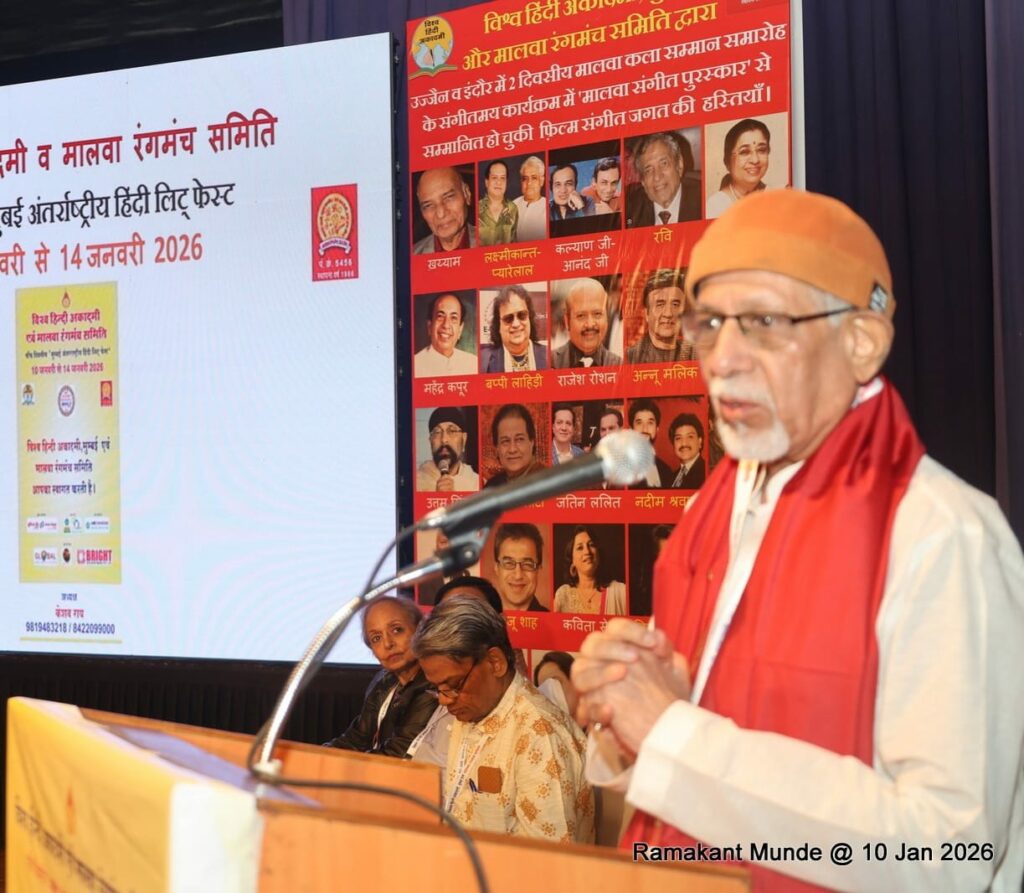
The Swarnim Bharat Manch honored him with a civic felicitation. On World Hindi Day, at the event organized by the World Hindi Academy at ISKCON Auditorium in Mumbai, selected verses from ‘Gita-Bharti’ were recited aloud for the first time.
This work is helpful in bridging the gap between India’s two major communities, because Arif says that all religions convey messages of peace and action.
Some examples illustrate the beauty of ‘Gita-Bharti’. In the Gita’s verse where Arjun’s despair is described, Arif writes: “Do hard work rigorously, perform selfless action. Do not worry about the fruit, action is human duty. Do action, just do action.”
Another stanza: “Come, say Satyamev Jayate and perform good deeds.” These verses not only preserve the original essence but also make them lyrical, which become even more impactful when set to music. Arif’s this creation makes the Gita a ‘companion’, revitalizing 5,000-year-old teachings in a modern context.
In conclusion, ‘Gita-Bharti’ is the essence of Pandit Mustafa Arif’s spiritual talent. This scripture not only conveys the Gita’s message in simple Hindi but also gives a message of religious unity. In a time when talks of division in society are common, Arif’s work reminds us that God is one and action is paramount. This creation will inspire future generations, and like Arif, we too should adopt the mantra ‘Do action, do not worry about the fruit’.